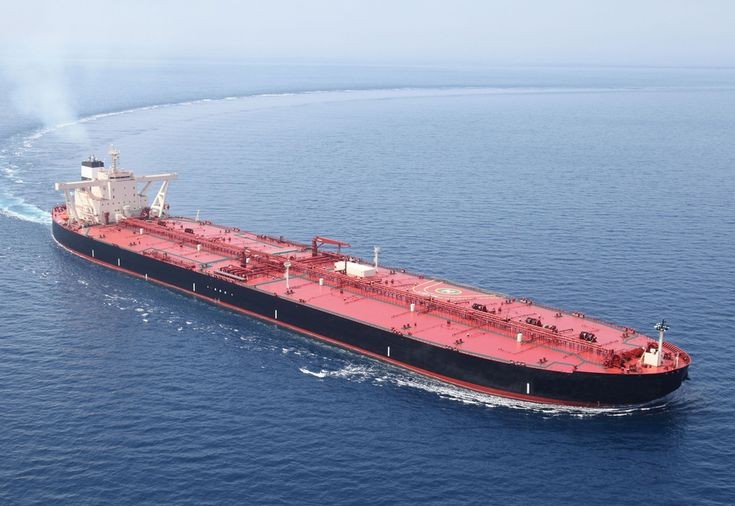
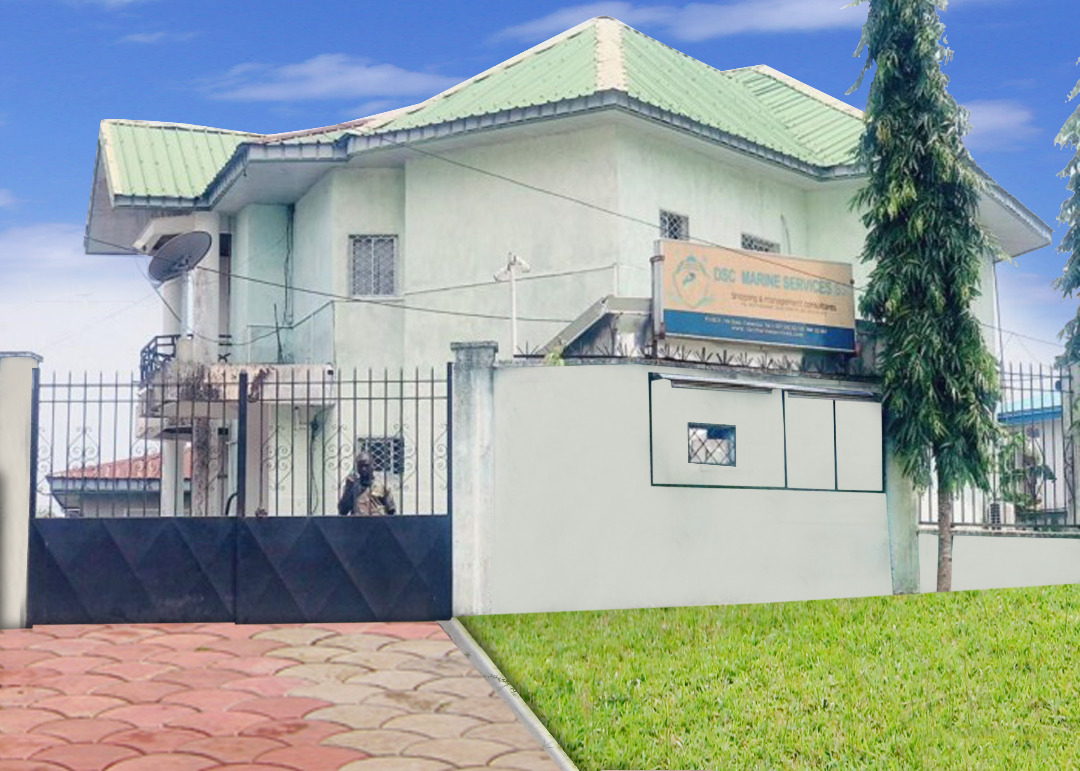

DSC Marine services S.A Excellente in shipping and logistics across the Gulf of Guinea

Established in 2015 DSC Marine S.A has been providing tramp shipping and port agency to a wide and diverse clients base around the Gulf of Guinea untill 2020 when the company externded its portfolio providing liner agency services. with emphasis on ethics strong human touch and innovation. DSC M arine services S,A dilivers high quality Marine shipping and logistics services to customers worldwide from our commercial headquaters in Limbe Cameroon just minute from cap Limboh terminal and our agency in Douala we are strategically placed to offer best services to our clients around the Gulf of Guinea
Even thoug the company has under gone tremendous changes within the short period of time our mission vision and values has not changed our global reached strong reputation and financial strenth places us in a better position to offer you a one parkege shipping and marine services that respect international and and national regulations saftey and the enviroment while securing the grouth of your company limiting cost and inhancing profitibility
HISTORY OF THE PORT OF LIMBE
1. Early colonial and pre‑port era (1858–1915)
The town of Limbe (initially named Victoria until 1982) was founded in 1858 by Baptist missionaries under German colonial rule.
A narrow‑gauge plantation railway was built in the early 1900s by the West African Planting Society Victoria, linking Soppo (near Buea) to the port of Victoria (now Limbe). This served both industrial and passenger traffic.
2. British rule and early port activity (1915–1960s)
During World War I in 1915, Limbe reverted to British control and formed part of British Cameroon.
The port remained small-scale, primarily serving nearby plantations exporting coffee, cocoa, bananas, rubber, tea, and palm oil. The Cameroon Development Corporation (CDC) and SONARA refinery later emerged as major local industrial players.
3. Post-Independence stagnation (1961–1999)
After independence (joined to Republic of Cameroon in 1961), development of Limbe’s port remained modest.
Underutilized port infrastructure saw little upgrade. Suggestions to expand or formalize the port were raised intermittently but lacked follow‑through.
4. Formal port status and initial planning (1999–2019)
In 1999, the government officially created the idea of a Limbe Autonomous Port, though it remained dormant for many years without implementation.
Pressure increased in the early 2000s: local political groups, chiefs, youth and women’s organizations petitioned for development of a deep-sea port, especially as a means to relieve congestion at the Port of Douala and support nearby heavy industries (SONARA, CDC).
The Major National Dialogue held in September–October 2019 reinforced the demand for port development in response to regional grievances in the Anglophone areas.
5. Reorganization and transitional administration (2020–2022)
On May 5, 2020, President Paul Biya issued decrees reorganizing and approving the status of the Port of Limbe as an autonomous entity (Limbe Autonomous Port).
On March 1, 2022, a transitional administration was installed for the Port Authority of Limbe (PAL) under Thomas Ndive Mulongo, marking a concrete step toward operational management and eventual construction (Cncc).
6. Planned deep‑sea port construction (2024–present, into 2030)
According to the Priority Investment Program (PIP), construction of the Limbe Deep Sea Port is scheduled to begin in 2026, with estimated cost around 400 billion FCFA (≈ USD 600 million), spanning about 5 years (until ~ 2030) (The New Cameroon).
The port is intended to handle heavy cargo: hydrocarbons, cement, containers, agricultural products. It aims to improve international market access for Cameroonian exports and attract foreign investment (The New Cameroon).
Projected job creation is significant: up to 7,000 direct jobs and ~20,000 direct + indirect jobs for the region.
Timeline Summary
| Period / Year | Key Developments |
|---|---|
| 1858 | Founded as Victoria by Baptist missionaries |
| Early 1900s | Railway built linking to port via plantation line |
| 1915 | Returns to British control |
| Post‑1961 | Independent Cameroon; port remains small industrial export hub |
| 1999 | Port formally “created” on paper but inactive |
| ~2000s–2019 | Persistent local demands for port development |
| 5 May 2020 | Presidential decrees formalize Limbe Autonomous Port |
| 1 Mar 2022 | Transitional authority (PAL) installed |
| 2026 (planned start) | Construction begins on deep‐sea port (5‑year project) |
| ~2030 (estimated) | Port expected to be fully operational |
Strategic & Socioeconomic Significance
Relieves congestion at the Port of Douala and diversifies Cameroon’s maritime infrastructure.
Supports SONARA refinery, CDC plantations, and local industry.
Stimulates regional development, particularly in South‑West region, by creating jobs and infrastructure growth.
Enhances regional trade integration (CEMAC countries, Nigeria, West and Central Africa).
Advances government strategy of balanced development and political inclusion, responding to Anglophone region demands.
BREF DESCRIPTION ABOUT US
The Port of Limbe is a secondary seaport located in the South-West Region of Cameroon, along the Atlantic coast near the city of Limbe. It is currently under development to become a strategic alternative to the country’s main port in Douala.